TECHNICAL CASE
Why Tropical Data Centers Still Need Insulation, Vapor Control and Breathable Membranes
A building-envelope reference for continuously cooled metal-roof buildings in hot-humid climates.
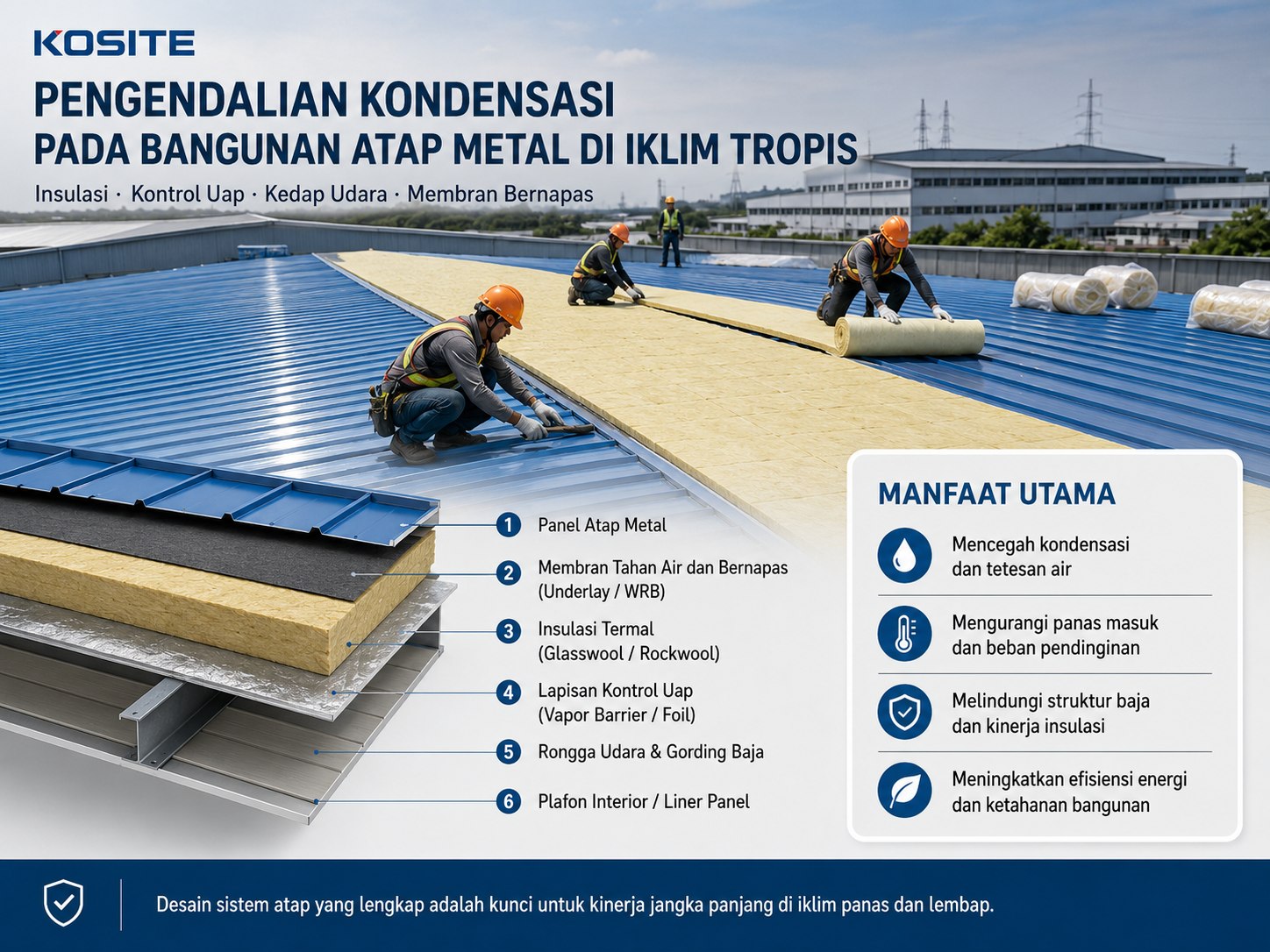
Indonesia's tropical climate does not eliminate condensation risk. In continuously cooled buildings such as data centers, AI facilities, equipment rooms, clean rooms and temperature-controlled warehouses, hot humid outdoor air can enter a roof or wall assembly and reach cold metal, concrete or insulation surfaces. When a surface falls below the dew point, condensation can form.
The consequences may include wet insulation, reduced thermal performance, corrosion of steel components, dripping water, mold, material deterioration and higher cooling demand. Insulation alone is therefore not a complete solution.
A coordinated roof and wall system
Roof and wall assemblies for continuously cooled buildings must manage heat transfer, rainwater, humid-air leakage, water-vapor movement, drainage, condensation and long-term drying. Each layer has a different role.
1. Thermal insulation
Insulation reduces heat transfer and supports stable indoor conditions. It must stay dry: moisture can reduce its thermal value and increase the corrosion risk of nearby steel elements.
2. Air sealing
An air-control layer limits humid-air leakage through panel joints, fasteners, roof-to-wall transitions, cable penetrations, doors, louvers and equipment supports.
3. Vapor control
A vapor barrier or retarder manages water-vapor diffusion. Its correct position depends on outdoor humidity, indoor cooling, insulation location, structural materials and the intended drying direction.
4. Waterproof breathable membrane
A waterproof breathable membrane provides secondary protection against external liquid water while supporting vapor transmission where the assembly needs a drying path. It is not automatically a vapor barrier.
5. Drainage and flashing
Water passing the exterior covering needs a continuous route outward. A membrane cannot correct reverse laps, blocked drainage paths, unsealed penetrations or incorrect flashing.
6. System compatibility
Membrane, tape, sealant, flashing, insulation, cladding and drainage layers must be specified and installed as one coordinated system.
Selection and detailing checks
- Confirm water resistance, vapor permeance or Sd value, mechanical strength, exposure limits and installation method for the selected membrane.
- Review roof and wall transitions, penetrations, window or louver openings, fasteners and drainage routes before material approval.
- Specify compatible tapes and flashings so joints remain continuous during construction and service.
- Determine the vapor-control strategy from the local climate, indoor cooling conditions, insulation position and complete assembly, not from a copied cold-climate detail.
Indonesia and hot-humid climate context
Indonesia's energy-conservation framework includes Government Regulation PP No. 33/2023 and SNI 6389:2020 for building-envelope energy conservation. These references reinforce that roof and wall design affects solar heat gain, cooling demand and building performance.
Australia's National Construction Code also distinguishes hot-humid climate zones and requires relevant pliable external-wall membranes to meet AS 4200.1 and to be installed in accordance with AS 4200.2. The useful principle is that membrane performance and installation are separate but equally important.
Technical note
This page is a technical discussion, not a project-specific design approval. Final membrane, insulation, vapor-control and air-sealing details must be verified by the project designer against the local code, building use, climate, test reports and complete assembly requirements.