Home > Cases & Technology
Building Envelope Cases & Technical Guides
Application references and technical guides for WRB, housewrap, breathable wall membrane and roofing underlayment.Waterproof Breathable Membrane: The Balance Between Water Resistance and Vapor Permeability
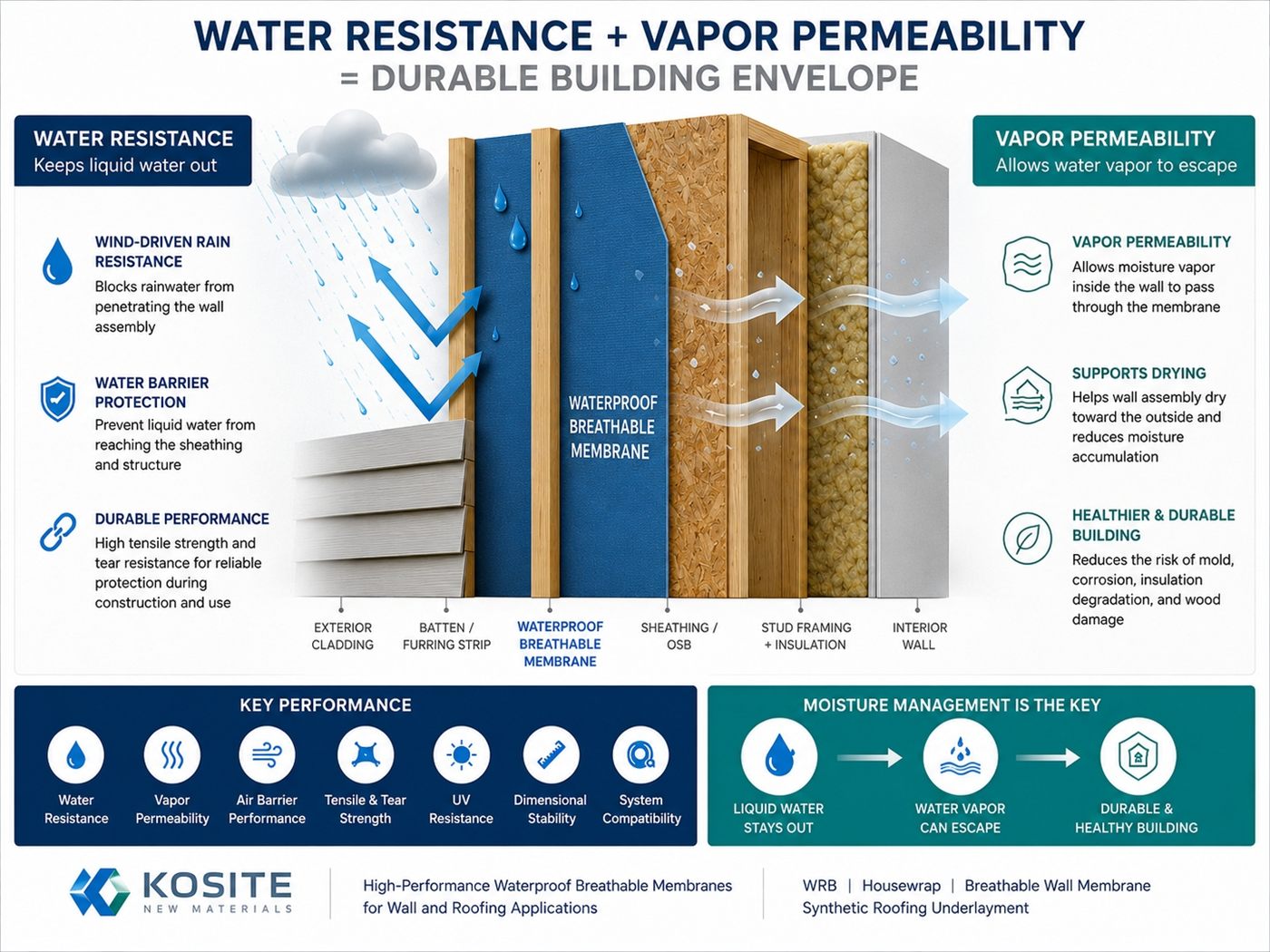
In building envelope applications, a waterproof breathable membrane is not simply a waterproof sheet.
Its technical value comes from balancing two different functions at the same time: blocking liquid water from entering the structure, while allowing water vapor inside the wall or roof system to escape.
This balance is very important for long-term building durability.
In external wall and roofing systems, moisture can enter or accumulate in different ways: wind-driven rain, construction moisture, indoor vapor movement, temperature differences and condensation inside the wall or roof cavity.
If the membrane only provides water resistance but has poor vapor permeability, moisture may become trapped inside the structure. Over time, this may lead to condensation, mold growth, reduced insulation performance, corrosion of metal components and damage to timber or sheathing boards.
Key performance factors
- Water resistance
- Vapor permeability
- Air barrier performance
- Tensile strength
- Tear resistance
- UV resistance during construction exposure
- Dimensional stability
- Compatibility with tapes, fasteners, battens, cladding and roofing systems
In real building applications, the membrane works as a hidden but critical layer behind the exterior cladding or roofing system. It helps protect the structure from external moisture while supporting the drying ability of the wall or roof assembly.
From a technical point of view, waterproof performance and vapor permeability should never be evaluated separately.
If a membrane has strong water resistance but very low vapor permeability, moisture may be trapped inside the wall or roof assembly. The structure may look protected from the outside, but internally it may face condensation, mold growth, insulation degradation and long-term durability problems.
On the other hand, if a membrane has very high vapor permeability but insufficient water resistance, it may not provide reliable protection against wind-driven rain, temporary construction exposure or moisture penetration through cladding joints, roofing overlaps and fixing points.
This is why the real value of a waterproof breathable membrane is balance.
A professional WRB, housewrap or roofing underlayment should be able to stop liquid water while allowing water vapor to pass through at a controlled rate. It should help the building envelope stay protected from outside moisture and still maintain the ability to dry from the inside.
Waterproof performance protects the structure. Vapor permeability helps the structure dry. The balance between both determines long-term wall and roof durability.
A good membrane is not only a barrier. It is a moisture management layer inside the building envelope system.
At PT KOSITE NEW MATERIALS, we focus on waterproof breathable membrane solutions for wall and roofing applications, including WRB, housewrap, breathable wall membrane and synthetic roofing underlayment.