Technical Resources
Five Technical Factors for Housewrap and WRB Performance
A practical technical guide for selecting waterproof breathable membrane, housewrap and WRB products by water resistance, vapor permeance, installation continuity, durability and application data.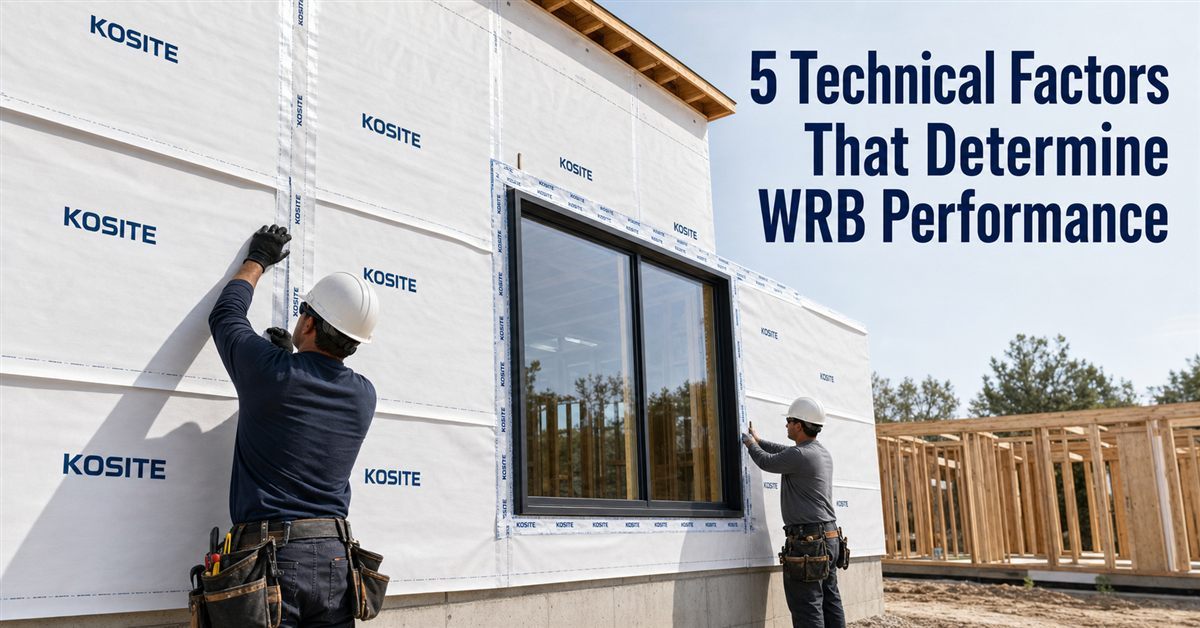
A Waterproof Breathable Membrane Is Not Just a Sheet
In exterior-wall construction, a waterproof breathable membrane is expected to perform two related but different functions: resist liquid-water penetration and allow water vapor to pass through the wall assembly when drying is required.
Selecting a housewrap or water-resistive barrier only by weight, color or initial water resistance can create performance risks. Building-material companies, distributors and private-label buyers should evaluate the membrane as part of the whole wall system.
- A WRB should resist liquid-water penetration while allowing controlled vapor drying.
- Weight, color and initial water resistance are not enough for product selection.
- Installed performance depends on flashing, overlaps, fasteners, penetrations and system compatibility.
1. Water resistance
The primary function of a WRB is to prevent bulk water from reaching moisture-sensitive wall components. The 2024 International Building Code requires a continuous water-resistive barrier behind exterior wall veneer and recognizes approved WRB systems, including ASTM E2556 Type I or Type II materials.
Laboratory water resistance is important, but installed performance also depends on laps, fasteners, penetrations and flashing details.
2. Vapor permeance
Breathable does not mean that air freely passes through the membrane. In this application, it normally refers to the membrane ability to transmit water vapor.
A vapor-permeable WRB can provide an outward drying path when moisture enters the wall assembly. The correct permeance level should be considered together with climate zone, insulation type, sheathing and interior vapor-control layers.
The objective is not maximum vapor permeance. The objective is balanced moisture management.
3. Continuity and flashing integration
A high-performance membrane cannot compensate for poor installation. The WRB should remain continuous around windows, doors, corners, penetrations and transitions.
Flashing should direct water onto the drainage plane and toward the exterior. Membrane compatibility with flashing tapes, sealants and adjacent materials should be evaluated before a wall system is specified.
4. Mechanical durability
WRB materials can be exposed to wind, fastener stress and handling damage before cladding installation. A technically balanced membrane must survive transportation and installation while maintaining its water-resistive function.
- Tensile strength
- Tear resistance
- Fastener pull-through resistance
- Dimensional stability
- UV exposure resistance
- Low-temperature flexibility
5. Product data must match the application
Exterior-wall housewrap, roofing underlayment and facade membranes do not have identical performance requirements. Before selecting a membrane, buyers should define the real application and the approval route.
- Wall, roof or facade application
- Mechanically attached or self-adhered installation
- Required water resistance and target vapor permeance
- UV exposure period and fire-performance requirement
- Roll dimensions, basis weight and private-label specification
- Applicable test standards and certification route
KOSITE manufacturing support
KOSITE manufactures housewrap, WRB and waterproof breathable membranes for exterior-wall, roofing and facade applications.
Supported by 20 years of production experience and manufacturing capability in Indonesia, KOSITE works with OEM and private-label customers to develop products around specific performance, roll-format and market requirements.
A reliable WRB should not be treated as a commodity sheet. It should be evaluated as part of a complete moisture-management system.
Technical basis and references
The technical discussion in this article is based on building-code provisions, ASTM standards and building-science guidance for water-managed exterior walls.
Important technical note
Building-code requirements vary by jurisdiction, building type, climate zone, cladding system and adopted code edition. References to ASTM or IBC provisions are provided for technical discussion and do not mean that every KOSITE product automatically complies with every referenced standard.
Product compliance should be confirmed using the applicable test report, product specification, evaluation report and project requirements for the intended market. KOSITE works with OEM and private-label customers to define the required application, test route and performance specification before product development or production.