Knowledge Center
What Is a Water-Resistive Barrier (WRB)?
A clear technical explanation of WRB function, drainage, vapor permeability and the checks buyers should make before selecting housewrap.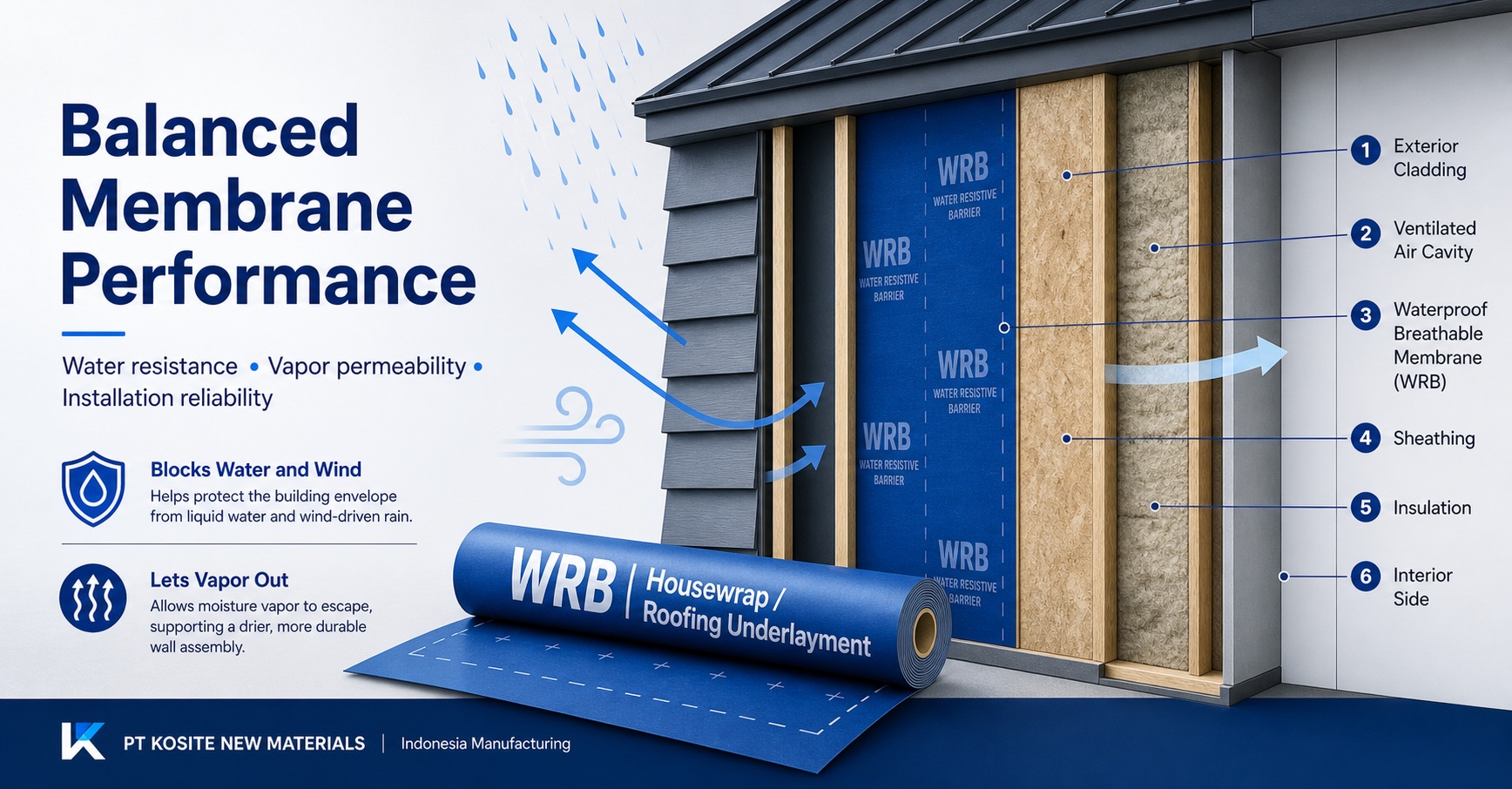
What Does a WRB Do in an Exterior Wall?
A water-resistive barrier, commonly called a WRB or water resistive barrier in buyer searches, is a continuous layer behind exterior cladding that helps prevent liquid water from reaching moisture-sensitive wall components. Housewrap is one common form of mechanically attached WRB.
A WRB works as part of a water-managed wall. Exterior cladding sheds most rain, while the WRB provides a secondary drainage plane for water that passes the cladding joints.
- A WRB manages liquid water; it is not automatically an air barrier or vapor retarder.
- Continuity at laps, windows, doors, penetrations and wall transitions determines installed performance.
- Product selection should match the cladding, exposure, climate, wall build-up and applicable project requirements.
1. WRB, air barrier and vapor retarder are different functions
A WRB controls rainwater. An air barrier limits uncontrolled airflow. A vapor retarder limits water-vapor diffusion. One material may perform more than one function only when the product and installed assembly are designed and documented for those functions.
2. Why drainage and flashing matter
The WRB should connect with window, door and penetration flashing so water is directed onto the drainage plane and then to the exterior. Reverse laps, open cuts and incompatible tapes can interrupt that path.
3. What buyers should verify
- Water resistance and applicable test method.
- Vapor permeance where the wall relies on outward drying.
- Tensile, tear and fastener-related durability.
- Exposure allowance and compatibility with flashing tapes, sealants and cladding attachments.
- Roll width, roll length, printing, labels and project-specific installation instructions.
4. Code and standard context
The 2024 International Building Code, Chapter 14, addresses weather protection, water-resistive barriers and flashing for exterior walls. ASTM E2556/E2556M covers vapor-permeable flexible sheet WRBs intended for mechanical attachment. BS EN 13859-2 addresses flexible underlays used behind external wall coverings in the European market.
These references have different roles: a building code defines assembly requirements, while a product standard defines characteristics and test routes. They do not prove that every KOSITE membrane complies. Final compliance must be confirmed for the exact product, test report, assembly, jurisdiction and adopted code edition.