Exterior Wall WRB and Breathable Housewrap
Vapor-permeable exterior wall WRB and breathable housewrap for cladding systems that need liquid-water protection and a controlled outward drying path.
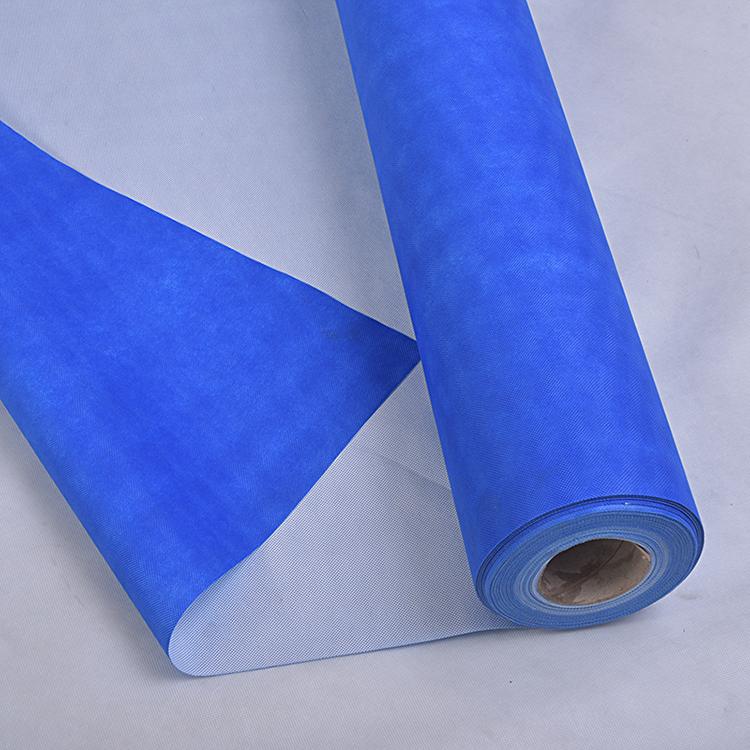
Controlled Membrane Grades and Technical Data
Three-layer PP nonwoven / breathable film / PP nonwoven. Standard roll: 1.50 m x 50 m (75 m²). Nominal basis weight tolerance: ±5%. The linked TDS defines the application, test methods, tolerances and limitations for each grade.
| Grade / nominal mass | Intended application | Water tightness | Sd maximum (m) | Tensile MD / transverse (N/50 mm) | Controlled source |
|---|---|---|---|---|---|
| 100 g/m² | Wall WRB / housewrap | W1 | 0.012 | 150 / 100 ±15% Measured MD / TD |
KOS-TDS-WM100-2026, Rev. 01 PDF |
| 150 g/m² | Wall WRB / housewrap | W1 | 0.012 | 225 / 150 ±15% Measured MD / TD |
KOS-TDS-WM150-2026, Rev. 01 PDF |
Water tightness: EN 1928, Method A. Sd: EN ISO 12572. Tensile: EN 12311-2 for the wall grades; EN 12311-1 / EN 13859-1 for the roofing grades. Values from different test methods must not be treated as interchangeable. These TDS do not declare a reaction-to-fire classification.
A wall grade is not automatically a roof underlay, and a breathable underlay is not a vapour barrier. Confirm the current controlled revision and the approved assembly before ordering. Custom grades and roll formats require separate specification approval.
Housewrap manufacturer and OEM supply | Controlled Building Envelope SDS
Vapor-Permeable Membrane for Exterior Walls
- Used behind exterior cladding as a water-resistive layer while supporting a vapor-open wall design.
- Helps the wall assembly manage wind-driven rain and retain a controlled drying path when matched to the project build-up.
- Roll width, basis weight, color, printing and packing can be specified for project and OEM supply.
- Drainable housewrap and self-adhered WRB constructions can be developed for confirmed substrates, drainage requirements, adhesive systems and target-market test routes.
How a Vapor-Permeable Wall Membrane Supports Drying
- Vapor permeability describes water-vapor diffusion, not uncontrolled air leakage. Air-control performance must be confirmed separately where required.
- Select the membrane with the wall build-up in mind: cladding, cavity, sheathing, insulation, indoor vapor control and climate all affect the required vapor behavior.
- Water resistance, vapor permeance, tensile strength, tear resistance and construction exposure should be reviewed as one specification.
- Laps, flashing, penetrations and compatible tapes determine whether the vapor-open drainage plane remains continuous after installation.
Vapor-Permeable Wall Membrane Checklist
- Confirm that the exterior-wall assembly needs a vapor-permeable membrane rather than a low-permeability vapor-control layer.
- Review the target vapor permeance together with water resistance, strength, UV allowance and the selected cladding system.
- Confirm wall orientation, roll width, roll length, color, printing, labels and export packing before quotation.
- Verify compatibility with flashing tapes, seam tapes, sealants and adjacent substrates before bulk production or installation.
- Use the approved project specification, product data sheet and destination-market requirements for final selection.
Related Technical Resources
Use these application notes with the selected product data sheet and project specification.
Water Resistance + Vapor Permeability
Why a durable exterior wall needs a balanced moisture-management layer.
How Waterproof Breathable Membranes Work in Walls and Roofs
How liquid-water protection and controlled vapor diffusion work together.
WRB Installation Guide for Water-Managed Wall Systems
Installation guidance for laps, openings, flashing and drainage-plane continuity.