Technical application guide | Reviewed 29 September 2026
Roof ridge details affect the performance of the whole roof. For a compatible dry-fix tiled roof, the ridge must coordinate ventilation, weather protection, material interfaces and mechanical fixing. A ventilation roll is one component of that detail, not a complete roof system.
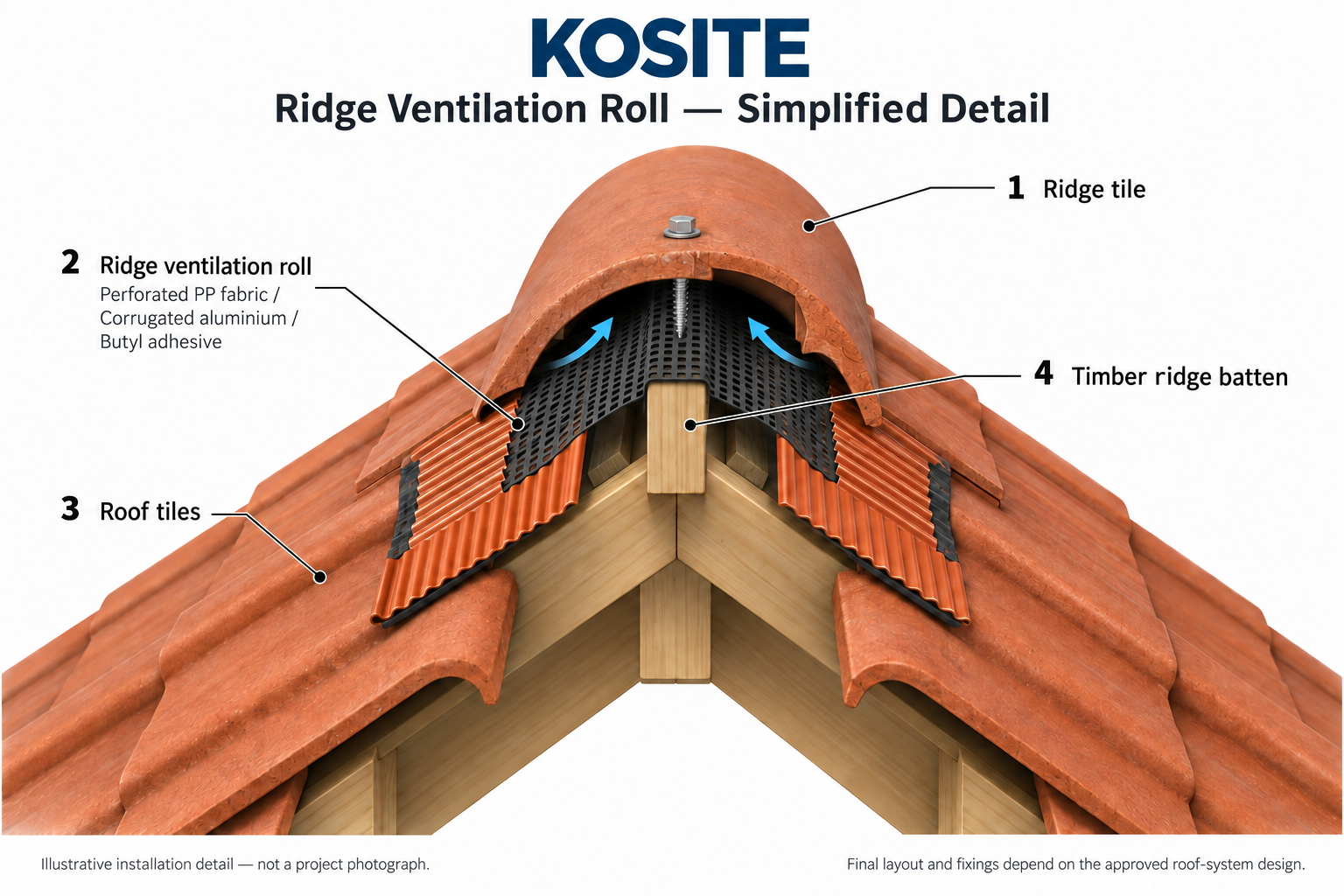
Why does the roof ridge matter?
The ridge connects the two roof slopes and may form a high-level ventilation outlet. It also contains joints and exposed edges that must be detailed for the roof covering, pitch, wind exposure and local conditions.
Assess airflow, drainage, fixing and moisture control together. A ridge that appears sealed from outside may still have a blocked air path; a ventilating centre does not, by itself, establish resistance to wind-driven rain.
What does a ridge and hip ventilation roll do?
The confirmed KOSITE sample combines a perforated polypropylene fabric centre, corrugated aluminium edges and butyl adhesive strips. Its intended application is beneath ridge or hip tiles in compatible dry-fix tiled roof systems.
| Component | Intended function | What must be checked |
|---|---|---|
| Perforated PP fabric centre | Provides an airflow pathway beneath the ridge covering. | Clear installed air route, perforation layout and product-specific ventilation evidence. |
| Corrugated aluminium edges | Conform to the compatible tile profile. | Contact at tile crests and valleys, without tears, bridging or forced stretching. |
| Butyl adhesive strips | Bond the edges to suitable tile surfaces and help seal the interfaces. | Surface compatibility, cleanliness, dryness, application conditions and bond continuity. |
| Ridge batten and tile fixings | Support and mechanically secure the ridge covering. | System-specified support, connectors, fixing arrangement and wind-load assessment. |
These functions describe the sample construction. They do not constitute a certified ventilation rate, weather-resistance classification or service-life claim.
How should ridge ventilation connect to the rest of the roof?
For a roof design that uses eaves-to-ridge ventilation, confirm suitable low-level inlets, a continuous route through the intended ventilated space and an unobstructed high-level outlet. The position of the underlay, insulation and ridge support must agree with that route.
Determine whether the design ventilates the roof space below the underlay, the space above it, or another defined cavity. Do not create a generic cut at the ridge: underlay termination and continuity must follow the selected roof-system instructions.
Effective installed ventilation depends on the complete passage, not simply the visible perforation area of a fabric. Hips and ridges are not automatically equivalent ventilation outlets; confirm their intended role in the project design.
Can a breathable roofing membrane replace roof ventilation?
No universal substitution should be assumed. Vapor permeability is a material property, whereas ventilation involves air movement through a designed route. Underlay type, ceiling airtightness, insulation, indoor moisture conditions and roof configuration affect the required strategy.
Review the entire roof build-up with the designer. The ridge roll is not a continuous waterproof roofing membrane and cannot replace underlay, a vapor-control layer or ceiling air sealing where these are required.
Why are butyl adhesion and mechanical fixing separate checks?
Butyl strips attach the roll edges to compatible tile surfaces. They do not replace the specified mechanical fixing of ridge or hip tiles.
Dust, moisture, surface treatments or poor contact can compromise the bonded interface. Confirm the ordered adhesive specification and substrate preparation, then press the shaped edges into full contact in accordance with the approved instructions.
What should installers inspect before covering the detail?
- Confirm tile profile, pitch, ridge batten height, air route and fixing components against the approved detail.
- Position the roll centrally, keeping the perforated centre intact and free from obstructing material.
- Shape the aluminium edges to the tiles without leaving unsupported bridges or damaging the fabric.
- Prepare compatible clean, dry surfaces and press the butyl strips into continuous contact.
- Complete overlaps, ends and junctions to the selected specification without obstructing the intended outlet.
- Mechanically secure ridge or hip tiles using the specified system components.
- Record the finished detail and any repairs before access or visibility is reduced.
This guide does not prescribe universal overlap sizes, batten heights, adhesive widths or fixing spacings. Those parameters must come from the approved system, product instructions and project conditions.
Which standards are relevant?
- BS 8612:2018 – Dry fixed ridge, hip and verge systems for slating and tiling: a system-performance reference addressing fixing security, weather-tightness, durability and ventilation where required.
- BS 5534:2014+A2:2018 – Slating and tiling for pitched roofs and vertical cladding: a reference for design, performance and installation of slate and tile roof coverings and associated components.
- BS 5250:2021 – Management of moisture in buildings: a whole-building framework for evaluating moisture sources, transport and risks through design, construction and operation.
The links are public BSI standard summaries, not reproductions of paid clauses. Referencing a standard does not mean KOSITE or the illustrated assembly is certified to it. Projects outside the UK must also follow their applicable local regulations and system requirements.
What evidence should buyers request?
Confirm roll dimensions, usable ventilation zone, fabric and aluminium configuration, adhesive specification, intended tile surfaces and installation limits. Request relevant product or system evidence for ventilation, weather resistance, adhesion, fixing security and durability before accepting performance claims.
Keep the approved sample, specification revision, batch identification and installation instructions together. Roof-system suitability should be confirmed before bulk ordering; a sample photograph is not a substitute for test data.
Frequently asked questions
Does the butyl strip fix the ridge tiles?
No. It bonds the ventilation-roll edges. Ridge tiles require the roof system’s specified mechanical fixings.
Can this roll be used on every roof covering?
No universal compatibility is stated. Confirm the tile profile, roof pitch, substrate, air route and system detail. Metal, slate and unusual roof coverings require separate evaluation.
Does a perforated centre prove a particular airflow rate?
No. Installed ventilation requires product-specific evidence and a clear system air route. A perforation pattern alone does not establish installed capacity.