Application Guide
Breathable Roofing Underlayment for Metal Roof Systems
A practical reference for selecting and installing waterproof breathable underlayment beneath steel and covered roof systems.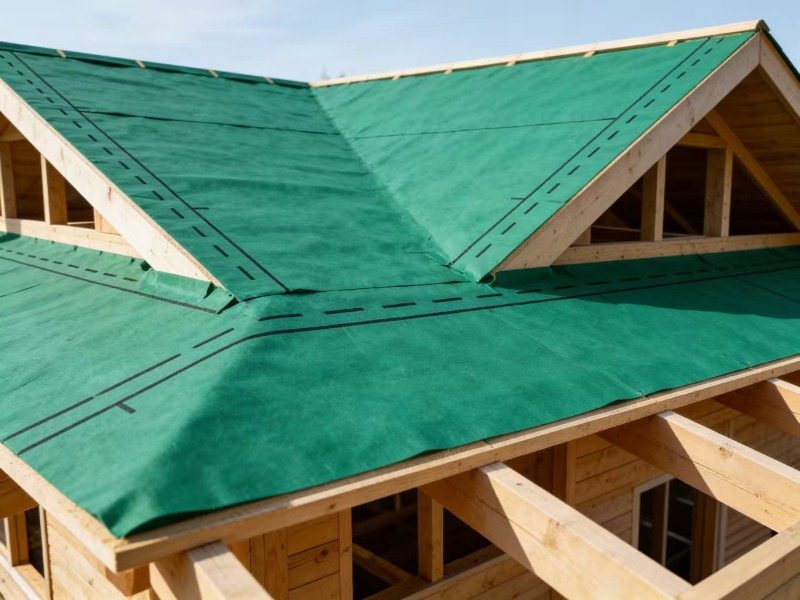
Steel Roof Underlayment: Application Conditions and Selection Checks
Steel-roof underlayment is a secondary protection layer beneath the final roof covering. It should manage water that passes the outer roof sheet and support drying within the roof assembly where the design requires vapor-permeable material.
The correct product depends on the roof build-up, slope, insulation position, expected construction exposure and installation method. Basis weight alone does not define suitability.
- Confirm the roof build-up and the final steel-sheet or covered-roof system before selecting a membrane.
- Review water resistance, vapor permeability, tensile strength and tear resistance together.
- Treat laps, fasteners, penetrations and roof-wall junctions as one continuous water-managed path.
1. Application conditions to confirm
- Roof slope, roof-sheet profile, insulation position and ventilation arrangement.
- Expected exposure period before the final roof covering is completed.
- Mechanical fixing method, overlap direction and penetration details.
- Whether the assembly needs vapor drying, vapor control or a different roof-layer design.
2. Product data to review
Water resistance and vapor permeability should be considered together. A breathable underlayment can support outward drying, but its vapor performance must match the complete roof assembly and local project requirement.
- Water resistance and water-vapor transmission.
- Tensile strength, tear resistance and fastener performance.
- UV exposure allowance, dimensional stability and low-temperature handling where relevant.
- Roll width, roll length, core size, color, printing and packing format.
Article page 2
3. Installation control points
Install the underlayment so upper sheets lap over lower sheets and water is directed toward the exterior. Maintain the required lap width and avoid reverse laps, open cuts and loose edges.
Seal or flash critical transitions, including pipe penetrations, roof-wall junctions, edges and repairs, using materials compatible with the selected membrane and roof system.
Article page 3
4. OEM and supply confirmation
KOSITE supports OEM and private-label roofing underlayment programs with specification review, samples, roll-format discussion, printing and export packing coordination. Final product selection should be confirmed against the project specification and applicable test documentation.