Technical Resources
Waterproof Breathable Membrane: Water Resistance and Vapor Permeability
A technical guide to balancing liquid-water resistance and vapor permeability in external wall and roof envelope systems.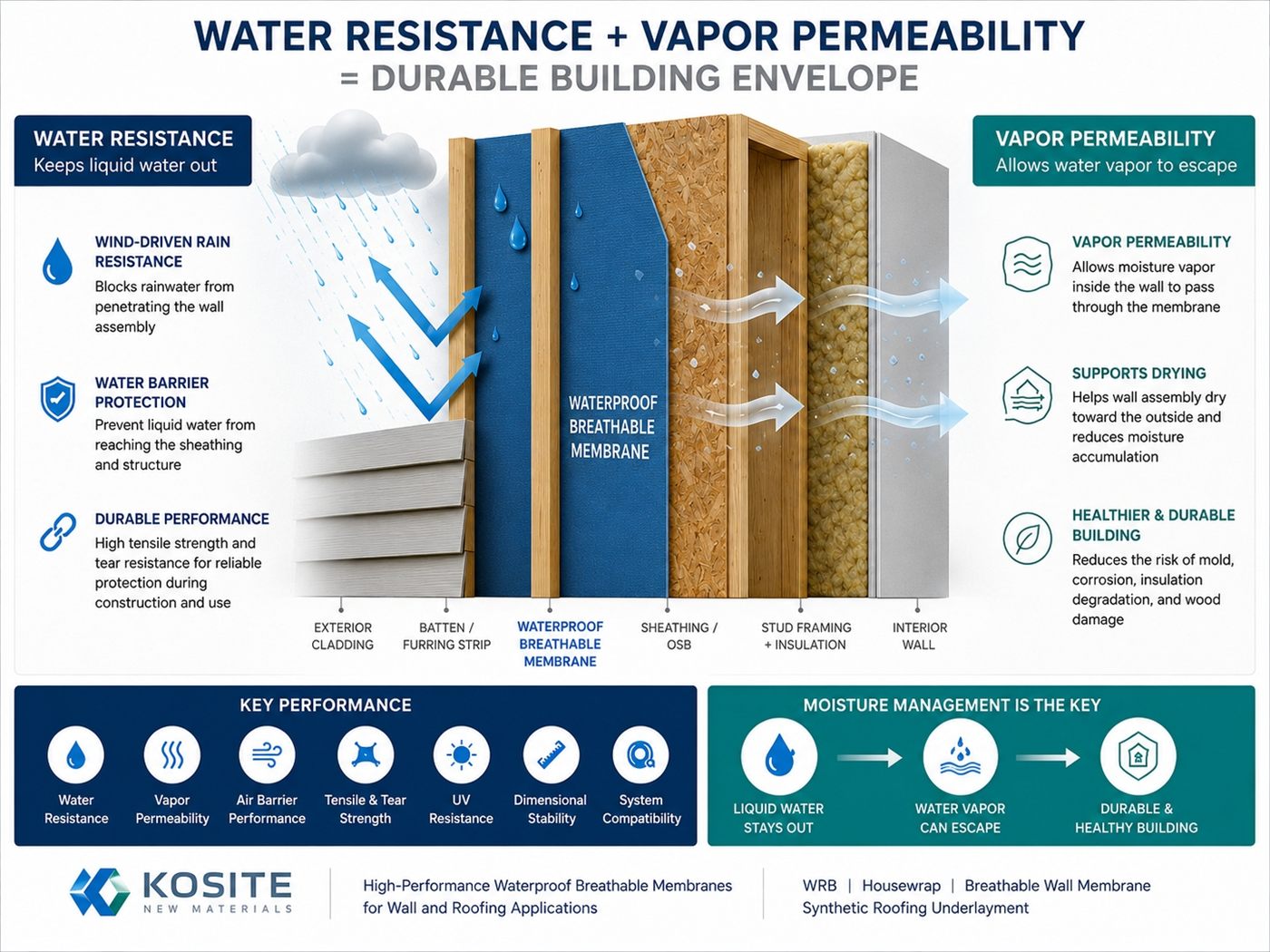
Waterproof Breathable Membrane: The Balance Between Water Resistance and Vapor Permeability
A waterproof breathable membrane is not simply a waterproof sheet. In a building envelope, it needs to resist exterior liquid water while allowing controlled water-vapor diffusion when the assembly needs to dry outward.
Moisture can enter or accumulate through wind-driven rain, construction moisture, indoor vapor movement and temperature-driven condensation. The membrane must therefore be assessed as part of a complete wall or roof system.
- Liquid-water control and water-vapor diffusion are separate performance functions.
- The correct balance depends on the complete wall or roof assembly, not one product value alone.
- Performance data, detailing and installation must be reviewed together.
1. Two functions, one membrane layer
Water resistance limits liquid water reaching sheathing, insulation and framing. Vapor permeability can provide a drying path for water vapor within an assembly. A vapor-open membrane does not mean uncontrolled air leakage; air control requires its own tested system design and continuous detailing.
2. What happens when the balance is wrong
A membrane with insufficient vapor permeability may contribute to trapped moisture when the wall or roof relies on outward drying. A membrane with insufficient water resistance may not provide reliable protection during wind-driven rain, construction exposure or water entry at cladding and roofing joints.
Neither extreme can be judged in isolation. The intended climate, insulation, interior vapor-control layer, cladding or roof covering and drainage path all matter.
3. Performance data to review
A suitable WRB, housewrap or roofing underlayment should be evaluated by multiple documented properties rather than one basis-weight or permeability figure.
- Water resistance
- Vapor permeability
- Air barrier performance
- Tensile strength
- Tear resistance
- UV resistance during construction exposure
- Dimensional stability
- Compatibility with tapes, fasteners, battens, cladding and roofing systems
4. System and installation checks
The membrane must remain continuous behind the cladding or roof covering. Laps, fasteners, flashings, window and door openings, penetrations and drainage paths determine whether the layer performs in practice.
Product compliance and suitability should be confirmed using the applicable test report, product specification and project requirements. Referencing a standard does not by itself establish compliance for every product or system.
5. KOSITE application support
KOSITE supports WRB, housewrap, breathable wall membrane and roofing-underlayment discussions with product samples, roll-format options and technical documentation. The final specification should always follow the intended application and the target market requirements.